
Merchant Account Terminated? What to Do Next to Restore Payment Processing
7 November 2026 • 1 Min Read
Introduction
Everything may be going smoothly for an online business until a sudden payment processing issue prevents customers from completing transactions. Sales records and bank statements may no longer match expectations, leaving business owners wondering why the expected funds have not arrived. The cause could be a technical fault, a freeze on funds or an account closure.
Many merchants expect advance notice, but processors can sometimes act first. Many agreements allow termination without cause with notice, as well as immediate termination for cause- for example, fraud or excessive chargebacks. Check your agreement for notice periods, early termination fees, and reserve terms. This guide explains what to do when your merchant account is closed, why it happens and how to restore payment processing.
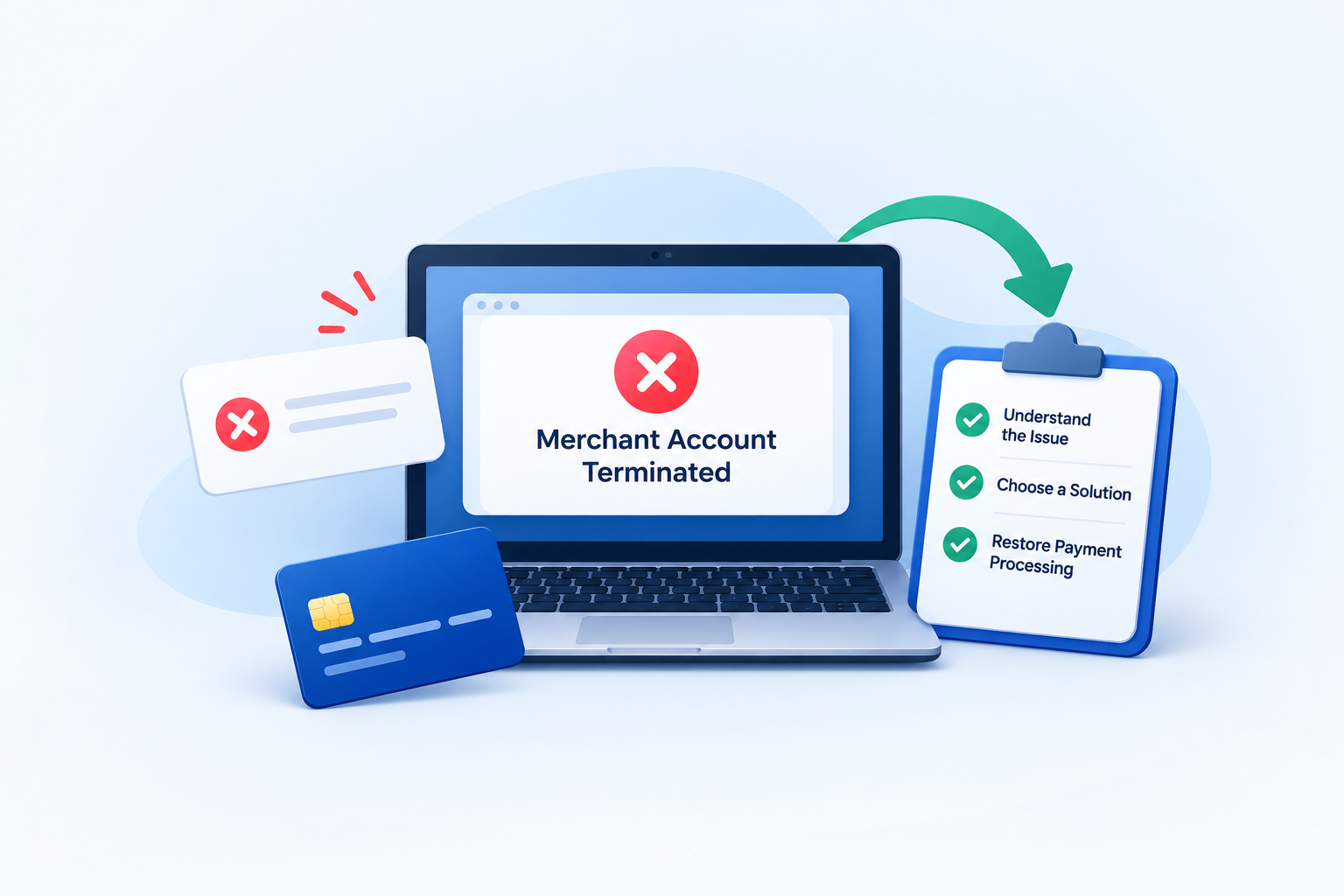
Quick answer: If your merchant account is closed, ask the processor for the reason in writing, confirm what happens to your funds, download your transaction records, respond to open disputes and apply to a processor that suits your industry. Funds are often held for several months, and a closure can affect future applications.
Why Was Your Merchant Account Closed?
Processors usually close accounts because of chargebacks, suspected fraud, compliance gaps, or a mismatch between the business and the account type. A payment processor may terminate your account if it detects risks that fall outside its policies. Before opening a new account, it is important to understand the reason for the closure.
Some of the main reasons include:
High volume of chargebacks:
A high volume of disputes and chargeback can pose financial risk to the payment processor. As of April 1, 2026, the Visa VAMP threshold of excessive merchant is 1.5%, whereas the Mastercard Excessive Chargeback Merchant is 1.5% with 100 chargebacks per month.
Suspicious activities:
Suspicious large amount transactions and other suspicious payment activities may result in the review of your account.
Non‑compliance:
Failure to verify information, outdated documents, or non‑compliance with regulations can result in account closure.
Misconduct:
Operating businesses that were not disclosed during account set‑up may violate the processing agreement.
Operating in a high‑risk sector on a standard account:
If your business operates in sectors such as supplements, subscriptions, travel, online gaming or gambling, or adult content, you may need a specialist payment processor (see our high‑risk merchant account page).
Unexpected growth in sales volume:
Exceeding the processing volume can lead to further checks or termination of the agreement.
The reason matters because it determines how the problem should be addressed. A policy restriction requires a completely different response from non‑compliance or fraud. Ask for the reason in writing.
What Happens When a Merchant Account is Terminated?
A terminated merchant account can cause more than just the loss of ability to accept card payments. Other serious issues may also need to be addressed quickly.
Common consequences of termination include:
| Consequence | Why it happens | What to do |
|---|---|---|
| Funds holding | The processor may hold, as set out in the merchant agreement, pending transactions and funds to cover potential chargebacks and refunds. | Request the details of held funds and their reserve terms and release procedure in writing. |
| Disruption of sales | The current system no longer processes card payments, so customers cannot complete their purchases. | Offer other ways of payment to your customers while trying to get a new payment account. |
| Subscription failure | Recurring transactions cannot be processed, which may lead to cancellations and customer complaints. | Inform your subscribers about it and change their billing upon account approval. |
| Harder approvals | A previous account closure may lead other providers to scrutinise your application more closely. | Document the cause and your fixes, and apply with accurate, consistent information. |
| Cash flow issues | Delayed payouts can make it harder to pay suppliers or staff. | Plan for the delay and keep a cash buffer. |
These consequences do not automatically mean that the business has lost its funds permanently or can never accept card payments again. The outcome depends on the reason for closure, outstanding liabilities and the requirements of prospective payment processors.
How Long Will My Funds Be Held?
Processors may hold your funds after closure to cover chargebacks and refunds. The length of the hold depends on your agreement, and it may be several months. Holds are commonly tied to the chargeback window: card networks typically allow cardholders to dispute a payment within 120 days, and their rules allow more time in some situations. Timelines vary by contract, so check your agreement and ask the processor for a written release date.
Merchant Account Closed: What to Do First
After a closure, prioritise actions that protect your records, clarify what you are owed and restore sales.
1. Clarify the Reasons for Termination
Contact your previous payment processor and ask for the official reason for the closure. Find out whether the decision can be reconsidered, what other documentation may be required and whether the account was terminated because of limitations, rules violations or transaction related risks.
Check your agreement for notice periods, early termination fees and reserve terms. An official written response will also assist in explaining the situation to a new payment processor.
2. Find Out About Frozen Funds and Settlement Dates
Clarify the outstanding amount, any reserves, pending settlements, and schedule of the release schedule. Make copies of all responses and monitor any missed dates.
Funds may be frozen in order to cover potential future chargebacks or refunds, so the release schedule depends on the agreement and any liabilities remaining at the time of termination. Do not assume that every reserved amount will be released immediately.
3. Download Transaction Records
Save reports of transactions, processing statements, chargeback reports, refund history and other important documents before access to the former dashboard expires.
This step can help you determine the reason for the termination of the account and provide more detailed information on transactions to a prospective payment processor.
4. Resolve Open Disputes
Even after the account has been closed, address chargebacks by the applicable deadlines. Response deadlines are set by the processor, and are often short starting from a few days to a few weeks (Stripe cites 7–21 days), while cardholders may be able to dispute charges for months after a transaction.
Verify these timelines against current network and processor rules. Review all refund claims, update your billing descriptor so customers recognise the charge, and notify customers about terminated subscriptions and delayed orders. See our guide to chargeback prevention. This shows new providers that you manage risk.
5. Choose Alternative Payment Method
If card processing is unavailable, choose the most appropriate alternative methods of payment such as bank transfer, digital wallet, etc., depending on your company's country of operation, industry and the provider requirements.
If you need card payments back quickly, a specialist such as Cleffo’s high‑risk merchant accounts may be an option, subject to eligibility. Ensure that the chosen alternative method is applicable to your products and services and follows the regulations.
Warning: Never process payments through another business’s merchant account or merchant ID to keep selling. This is transaction laundering, violates card‑network rules, and may lead to a MATCH listing.
How to Recover After a Merchant Account is Closed
Don’t just look for a new processor. Reduce the risks that caused the closure before you reapply.
- Analyse chargeback patterns: Find out what customers dispute or complain about, including ambiguous invoicing, delivery problems and delays in processing of refunds.
- Enhance fraud protection: Consider using a transaction monitoring system, an address verification service, and 3D Secure where suitable for your business and customers.
- Updating of the compliance documents: Ensure that documents related to business registration, licenses, ownership, and identification are current.
- Business operations disclosure: Clearly explain the company’s products or services, subscription terms, sales methods, and expectations on underwriting.
- Clear customer policies: Inform customers about the pricing, delivery terms, and return policy to avoid any misunderstandings.
The new account provider needs to understand the business model and the reasons for account closure. Avoid submitting multiple applications with conflicting information, as discrepancies can complicate underwriting.
What is the MATCH list?
MATCH (Member Alert to Control High‑risk Merchants) is Mastercard’s database of terminated merchants. “Terminated Merchant File (TMF)” is the generic term for this kind of database, and MATCH was formerly known by that name. Other card networks have their own risk‑monitoring programmes, such as Visa’s VMSS. What is generally cited about MATCH:
- The listing is made by the acquirer that closed the account, not by the card network.
- It typically stays on the list for about five years.
- Listing is tied to specific reason codes, for example excessive chargebacks (in Mastercard’s rules, over 1% of sales transactions in a month with chargebacks totalling USD 5,000 or more) or transaction laundering (Stripe).
- You can ask the acquirer that listed you which reason code was used, and incorrect entries must be corrected through that acquirer.
If applicable, the termination can be registered in the card network terminated‑merchant database, for example, Mastercard's MATCH system, where the corresponding reporting criteria are satisfied. These databases will affect further decisions regarding underwriting, and businesses generally cannot gain access to the database.
Ask the former provider about the reporting and try to learn the relevant reason code. If the information in the database is wrong, follow the appropriate procedure for correction rather than assume that the record will be deleted.
When searching for a new processor, consider one with experience in your industry, and a clearly presented fee structure, settlement terms, and approval requirements. There are no providers who will guarantee approval despite the business risks.
Conclusion
The closure of the merchant account can disrupt revenue, but a well‑thought‑out recovery strategy can help businesses understand what went wrong, protect their funds and start accepting payments again. Analysing transactions, resolving disputes, and choosing a processor with relevant industry experience are important steps towards creating a stable payment arrangement.
Cleffo offers high‑risk payment processing with options such as no rolling reserve, a security deposit option and approval in 2–3 business days (for eligible businesses). Using tailored payment solutions, different payment methods and fraud protection services, Cleffo can assist businesses in finding the options that match their processing needs. Contact our team today to get a payment setup that meets business needs.
FAQs
1. What should I do if my merchant account is closed?
Ask for the closure reason in writing, confirm what happens to your funds, download your records and resolve open disputes. Then apply to a payment processor that suits your industry.
2. Why do payment processors close merchant accounts?
Common reasons include excessive chargebacks, suspected fraud, non‑compliance, concealed business activities, unanticipated transaction volume, and operating in a high‑risk industry on a standard account. Many agreements also allow termination without cause on notice.
3. Can I open another merchant account after termination?
Usually, yes, but it depends on the reason for closure and your business’s risk. If you are listed on the MATCH or have unresolved chargebacks, a specialist high‑risk merchant processor may be more suitable.
4. Will I get my funds paid out if my merchant account is closed?
Usually yes, minus any chargebacks, fees and reserves, but they may be held for weeks or months. The release of your funds is subject to any reserve requirements and unresolved disputes that you may still have. Check your agreement for the release terms.
5. How long will it take to open a new merchant account?
Depending on the processor and your industry, approval can take anywhere from a few business days to several weeks. Cleffo’s approval takes 2–3 business days for eligible businesses.
6. What is the MATCH list?
MATCH is Mastercard’s database of terminated merchants, also known as the Terminated Merchant File (TMF). Acquirers add merchants with a reason code, and listings typically last about five years. Ask the acquirer that listed you for the reason code and to correct any errors.
7. How long will my funds be held after closure?
It depends on your merchant agreement and is often several months, because holds are commonly tied to the chargeback window. Cardholders can typically dispute a payment within 120 days, and sometimes longer. Ask the processor for a written release date.